Through a convoluted series of clicking links and searching Wikipedia, I found out that Sony Pictures Animation, who made Surf's Up and Open Season is producing an adaptation of Cloudy with a Chance of Meatballs, a book that I have fond memories of from elementary school, and you probably do too. The book describes a town called Chewandswallow, where all of the weather is in the form of food. If you're not familiar with this book, ask someone who had a childhood.
I actually became somewhat excited about this, even though I feel a certain apprehension of translating a beautifully drawn children's book to CG. But honestly, this is probably one of the less stylized children's books, and thus is less dependent on being hand-drawn for its feel.
What absolutely enraged me, though, was that they plan to explain the origins of Chewandswallow's weather. I think Patton Oswalt put it best:
"I DON'T GIVE A SHIT WHERE THE STUFF I LOVE COMES FROM! I JUST LOVE THE STUFF I LOVE!"
Why the hell would they ruin a perfectly quirky and magical story with something like an explanation? Isn't what makes books like this so memorable the fact that it's so matter-of-fact about the situation, and it lets the kids escape to a world that is at once familiar to their own, yet completely alien from it? The book never asked kids to become the wet blanket in their first-grade class and ask "But teacher, how is such a town possible? Ground beef and soup don't occur naturally." Creating an origin story would just ruin this perfect fantasy because providing an explanation for the town would indicate that something had to make it that way, instead of the much more fun idea that that's just how things always were.
Come to think of it, why are producers/writers so enthralled with origin stories? As far as movies go, the only origin stories I've seen that I liked significantly and actually added something to the character/story were Batman Begins, Iron Man, and Indiana Jones and the Last Crusade. And even in those cases, one had ninjas, one had Robert Downey Jr., and one had a kickass chase scene and beautiful scenery. Well, what actually made the former two stories good , particularly in the realm of superhero origins, is that they were the rare self-made superheroes. Unlike most of Stan Lee's lazy "something radioactive happened" or "born that way" origins, in these cases character development --> superpowers instead of superpowers --> character development. Most of the time, again particularly in comic book movies, an origin story is a writer's easy way to fill 40 minutes without having to worry about a plot yet.
The fact is most of the time, not only do we not care how someone or something was created or became they way they are in the present, but often the presentation of an origin actually ruins the already established story *cough*starwarsprequels*cough*. Most filmmakers today seem to have forgotten that people like a little mystery, because they to fill in the blanks themselves. Darth Vader and Boba Fett were way cooler before I was spoon-fed the whole story about how they were kids with single parents (for a lack of a better word for the relationship between Jango and Boba Fett). That one shot in Empire Strikes Back when you saw the back of Vader's gross pink head, and then at the end of Return of the Jedi when you saw his gross pink face, were awesome because they pushed the question about what horrible event led to his condition. People were able to use their *gasp!* imaginations to answer it. More importantly, before Episode III spelled it out for us in the form of "He had a fight with Obi-Wan and he fell in some lava and caught on fire", it was easier to accept this condition as metaphorical; a visualization of how the Dark Side had corrupted him, and probably a thousand other metaphors depending on who you ask.
Fiction, particularly fantastic stories like surreal children's books, fantasy in its varying forms, and science fiction, is so great because the best of its storytellers are able to create a world that you can become immersed in and begin to believe in, with characters that you can feel like they exist on some other plane, and can imagine interacting with the world they live in.
The best worlds and characters in fiction already feel like they have lived a life/existence before the story began; you don't need to make up the whole life.
Say you have a black box with a bunch of white gaps in a checkerboard-like pattern. Now fill in all of the white with black. What's more interesting, the black-and-white block with the gaps, or the solid black box, with all of the gaps filled in?
Tuesday, June 10, 2008

Saturday, June 7, 2008
Brad Bird/Big Lebowski
Brad Bird
This occurred to me shortly after seeing Ratatouille for the second or third time, within the week-long period of seeing it four times in total, and a week after watching The Incredibles three times within a week. I feel like in many ways, Brad Bird is the Steven Spielberg of animated films, and in a broader sense American film today, especially if you consider Spielberg's earlier films. This idea struck me initially because of their shared talent for creating films that are both artistically viable without compromising commercial viability, and vice versa. However, after pondering this for a little longer, I realized that they shared other qualities.
Both showed a talent and passion for their medium from an early age, Spielberg with his little alien film that ended up being his very first film to make a profit, and Bird with his 3-year labor of animation that he sent to Disney and resulted in an apprenticeship with none other than Milt Kahl.
Both got a start in TV, Spielberg most famously for his TV movies like Duel, and Bird for his involvement in The Simpsons.
Hell, even The Iron Giant has a similar story to E.T. I'm sure there are more similarities than I've listed off the top of my head, but really what it comes down to is their pure and unbreakable passion for their genre.
The Big Lebowski
I don't know exactly how this occurred to me, but soon after watching The Incredibles and Ratatouille, the two Pixar films with probably the most human characters, I realized that The Big Lebowski has all the qualities of a great animated film. There's little denying that the characters are basically well-developed caricatures. The plot and dialogue are hilarious and absurd, and the visuals have a precision that is seldom matched by anyone besides the Coen Brothers themselves. Even though the hilarious dream sequence is probably the clearest argument for this, what really convinced me was imagining the "World of Pain" scene as if it was played by characters modelled and animated the way I would imagine Pixar would do it. Try, if you can, to imagine any scene from The Big Lebowski as if the movie was a really fucked up Pixar film, and it just works.
What this really got me thinking about, though, is the idea of choosing whether or not to make a movie animated. The thing about the Big Lebowski feeling like an animated film is that because it's live action, the ridiculous situations and caricaturistic characters make everything that much funnier and more ridiculous. However, by that logic, you might think that any animated film would be richer or whatever by going to live action. I think what should really be considered during this hypothetical choice is not how you want to present the characters and situations, but how you want to present the world you're creating. If you want the more improbable/impossible aspects of your film to blend in with the world of your movie, then that's what makes (well one thing) a successful animated movie.
If I go any longer, I'm going to veer off into a rant about CGI in live-action movies, so I'm going to stop here.
This occurred to me shortly after seeing Ratatouille for the second or third time, within the week-long period of seeing it four times in total, and a week after watching The Incredibles three times within a week. I feel like in many ways, Brad Bird is the Steven Spielberg of animated films, and in a broader sense American film today, especially if you consider Spielberg's earlier films. This idea struck me initially because of their shared talent for creating films that are both artistically viable without compromising commercial viability, and vice versa. However, after pondering this for a little longer, I realized that they shared other qualities.
Both showed a talent and passion for their medium from an early age, Spielberg with his little alien film that ended up being his very first film to make a profit, and Bird with his 3-year labor of animation that he sent to Disney and resulted in an apprenticeship with none other than Milt Kahl.
Both got a start in TV, Spielberg most famously for his TV movies like Duel, and Bird for his involvement in The Simpsons.
Hell, even The Iron Giant has a similar story to E.T. I'm sure there are more similarities than I've listed off the top of my head, but really what it comes down to is their pure and unbreakable passion for their genre.
The Big Lebowski
I don't know exactly how this occurred to me, but soon after watching The Incredibles and Ratatouille, the two Pixar films with probably the most human characters, I realized that The Big Lebowski has all the qualities of a great animated film. There's little denying that the characters are basically well-developed caricatures. The plot and dialogue are hilarious and absurd, and the visuals have a precision that is seldom matched by anyone besides the Coen Brothers themselves. Even though the hilarious dream sequence is probably the clearest argument for this, what really convinced me was imagining the "World of Pain" scene as if it was played by characters modelled and animated the way I would imagine Pixar would do it. Try, if you can, to imagine any scene from The Big Lebowski as if the movie was a really fucked up Pixar film, and it just works.
What this really got me thinking about, though, is the idea of choosing whether or not to make a movie animated. The thing about the Big Lebowski feeling like an animated film is that because it's live action, the ridiculous situations and caricaturistic characters make everything that much funnier and more ridiculous. However, by that logic, you might think that any animated film would be richer or whatever by going to live action. I think what should really be considered during this hypothetical choice is not how you want to present the characters and situations, but how you want to present the world you're creating. If you want the more improbable/impossible aspects of your film to blend in with the world of your movie, then that's what makes (well one thing) a successful animated movie.
If I go any longer, I'm going to veer off into a rant about CGI in live-action movies, so I'm going to stop here.
Wednesday, May 28, 2008
Still Pictures!
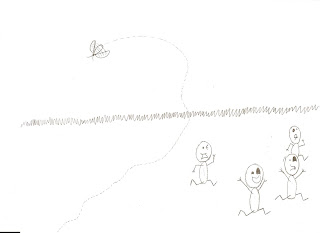
Okay, until I figure out how to link to a Quicktime video, here is the storyboard still by still. I worked too much on details for it to be diluted by yucky compressed format. 




Subscribe to:
Posts (Atom)